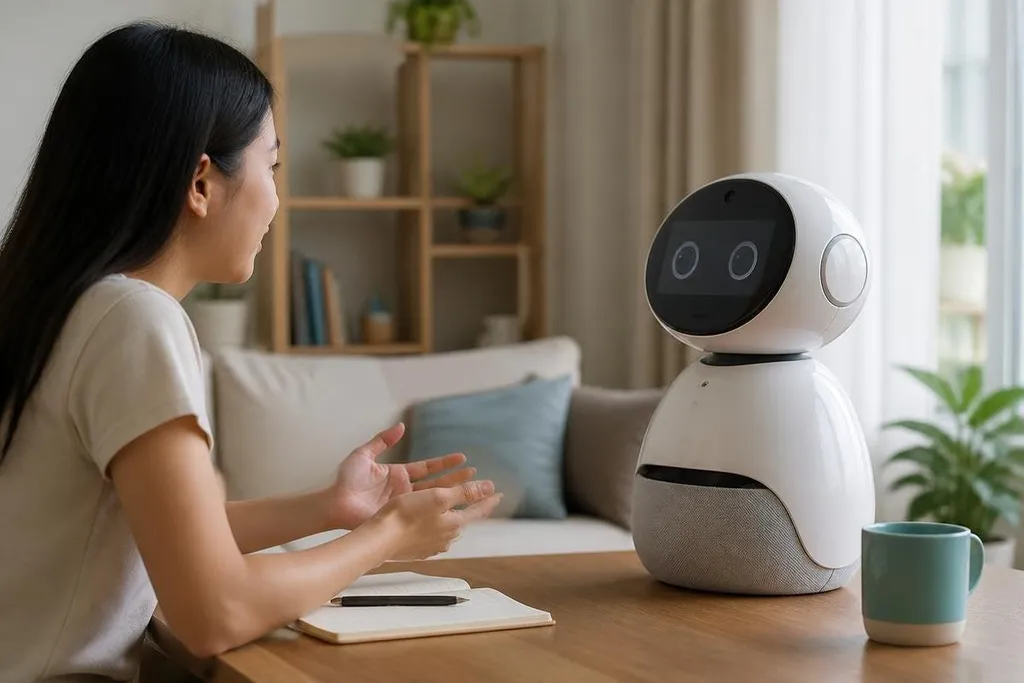
A language-learning robot could listen, speak, point, and repeat the same task without losing patience. For a learner, that may turn a short daily practice session into a spoken exchange instead of another screen-based quiz.
- Robots can give spoken practice at any hour.
- Cameras and microphones can link words to objects and actions.
- Human teachers remain needed for meaning, culture, and hard mistakes.
Speaking practice without an audience
Many learners understand written words before they feel ready to speak. A robot could offer a private place to try a sentence, hear a reply, and try again without the pressure of a class.
The robot would need speech recognition, which turns spoken language into text or commands. It could then compare the learner’s words with the expected phrase and ask for another attempt when the sound or meaning does not match.
That process works best for short, clear tasks. The robot might ask the learner to name an object, answer a question, or follow a spoken instruction. Each reply gives the system a new point to check.
Its body adds another way to practice. The robot can point to a cup, move toward a door, or hold up a card.
Those actions connect a word to something the learner can see, which may help beginners understand meaning without a long explanation in their first language.
Repetition that fits the learner
Language practice depends on meeting words more than once. It could bring back a word after a gap, then ask the learner to use it in a different sentence.
This is a form of spaced practice. The gap matters because recalling a word later takes more work than repeating it at once. A system that records which words caused trouble could select more practice for those words and less for words the learner already knows.
The useful part is the link between the record and the next task.
If a learner often misses a verb in spoken questions, the system could ask more questions using that verb. If the learner knows the word but says it poorly, it could switch from meaning practice to pronunciation practice.
That record also needs care. A speech system can misunderstand an accent, a quiet voice, or a word spoken with a regional sound. The robot should show what it heard and let the learner correct the mistake. A wrong score with no explanation teaches very little.
A language robot's value rests on what it can hear, correct, and explain during a lesson. Robot24.com robotics coverage can place those features beside named machines and test settings before the next section examines where speech tools still fail.
Where robots have limits
The machine can repeat a phrase, but it may struggle with humor, indirect requests, or a sentence that is grammatically unusual yet correct. Language carries local customs that a speech score cannot explain on its own.
A learner also needs more than correct sounds. They need to know when a phrase is polite, too formal, or likely to confuse someone. A teacher can explain why a sentence feels wrong in a certain setting; a robot may only mark it as different from its stored answer.
Privacy adds another concern. A language robot may process voice recordings, video, and information about a learner’s mistakes. Schools and families need clear rules about storage, access, deletion, and consent before placing one in a classroom or bedroom.
Cost and setup matter too. One that needs a stable network, careful calibration, or a separate account for every learner may be harder to run than a tablet. The body only earns its place when movement, pointing, or face-to-face speech helps with a task the screen handles poorly.
I'd skip a language robot that only reads flashcards aloud. Its value starts when its body and sensors give the learner a reason to speak, listen, or act.
A practical test before buying
Use these checks when comparing a robot for home study, a classroom, or a language lab:
- Spoken exchange: Check whether the robot can respond to open answers, rather than accepting one fixed phrase.
- Error feedback: Look for a plain explanation of the mistake and a chance to try again.
- Accent handling: Ask how the system deals with regional accents, background noise, and more than one speaker.
- Lesson control: Make sure a teacher or parent can set topics, review progress, and change the level.
- Data controls: Check where recordings go, how long they stay there, and who can view them.
- Body use: See whether pointing, movement, or objects improve the lesson enough to justify the robot.
The best use may be shared practice: a robot handles repeated speaking drills, while a teacher handles conversation, culture, and judgment. That division gives the learner more chances to speak without asking a machine to replace the person who understands why language changes from one place to another.